


Table of Contents
- March 18, 2026
- Pathik Shah
Key Takeaways – Hong Kong ML/TF National Risk Assessment
- The Hong Kong ML/TF National Risk Assessment is a comprehensive report that identifies and analyses money laundering and terrorist financing risks.
- The government focuses on five key areas, including enhancing the AML/CFT legal framework, strengthening risk-based supervision & partnerships, stepping up outreach & awareness-raising, monitoring emerging risks, and strengthening law enforcement efforts.
- Each sector poses significant ML threats and vulnerabilities and has a different risk rating, requiring effective supervision and controls.
What Is Hong Kong ML/TF National Risk Assessment
A Money Laundering and Terrorist Financing (ML/TF) National Risk Assessment (NRA) is a comprehensive and periodic evaluation that identifies, understands and analyses a country’s specific risks related to financial crime.
In Hong Kong, ML/TF NRA is conducted by the government and lays a foundation to strengthen the city’s efforts in combating financial crime and develop policies accordingly.
Further, the risk assessment report is set to meet international standards, such as those of the Financial Action Task Force (FATF). The Hong Kong latest ML/TF risk assessment report examines sector-specific ML/TF threats and vulnerabilities, the city as a whole, and proliferation financing risks.
Overall ML/TF /PF Risks in Hong Kong
As per the Hong Kong NRA, 2022, the overall ML/TF/PF risk is classified as below:
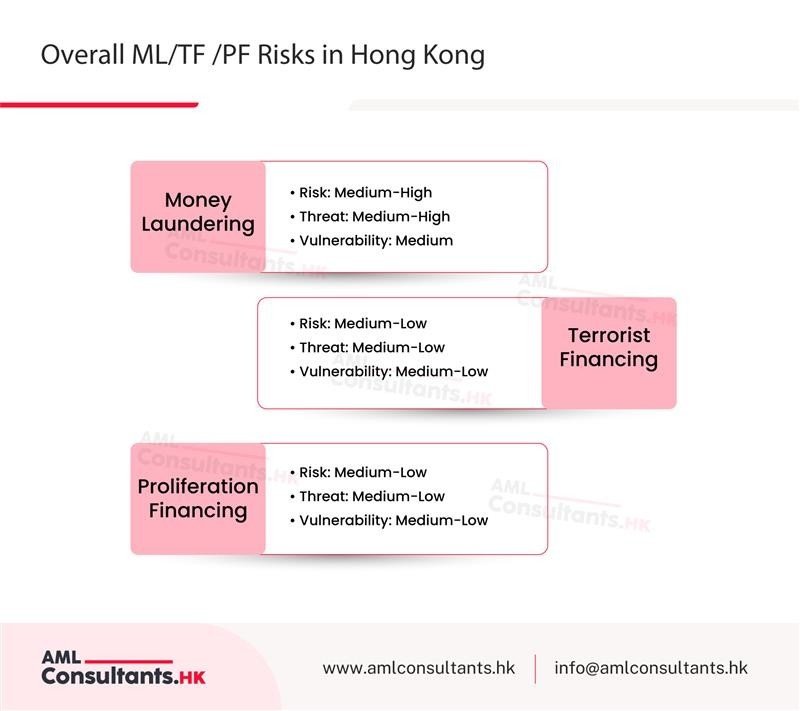
- Money Laundering Risk: Medium-High
- Money Laundering Threat: Medium-High
- Money Laundering Vulnerability: Medium
- Terrorist Financing Risk: Medium-Low
- Terrorist Financing Threat: Medium-Low
- Terrorist Financing Vulnerability: Medium-Low
- Proliferation Financing Risk: Medium-Low
- Proliferation Financing Threat: Medium-Low
- Proliferation Financing Vulnerability: Medium-Low
Key ML/TF and PF Risks and Themes in the Hong Kong NRA, 2022
The Hong Kong government published the newest Hong Kong ML/TF National Risk Assessment Report on July 8, 2022. It provides a holistic overview of the city’s vulnerability to financial crime and its responsiveness to combat ML/TF and PF risks.
The predicate offences linked with money laundering investigations and cases include fraud, drug trafficking, corruption, tax crime, robbery, burglary, theft, goods smuggling, loansharking, vice, gambling, human smuggling & trafficking, and others.
Key ML/TF and PF Risks and Typologies
The following are the ML/TF and PF trends and typologies identified in the Hong Kong ML/TF National Risk Assessment:
- Use of third parties (money mules) to transfer illicit money, providing small monetary gains.
- Misuse of bank accounts as temporary deposits that are quickly transferred overseas.
- Use of fraudulent trade practices (trade-based money laundering), such as over-invoicing and under-invoicing, to move illicit funds.
- Use of front or shell companies to disguise beneficial owners and the source of funds.
- Misuse of professionals such as accountants and lawyers as agents to conduct an audit on forged documents, or to facilitate ML activities.
- Use of hawala brokers, cash couriers, or money transfer services to finance terrorism.
- Use of social media platforms, crowdfunding, or virtual asset services to raise funds for illicit activities.
- Creation of complex corporate structures to hide links or the true owners.
Key Hong Kong NRA Implications and Themes
The following are Hong Kong NRA findings or five key areas of work in response to the specific ML/TF risks for enhancing the AML/CFT and CPF regimes.
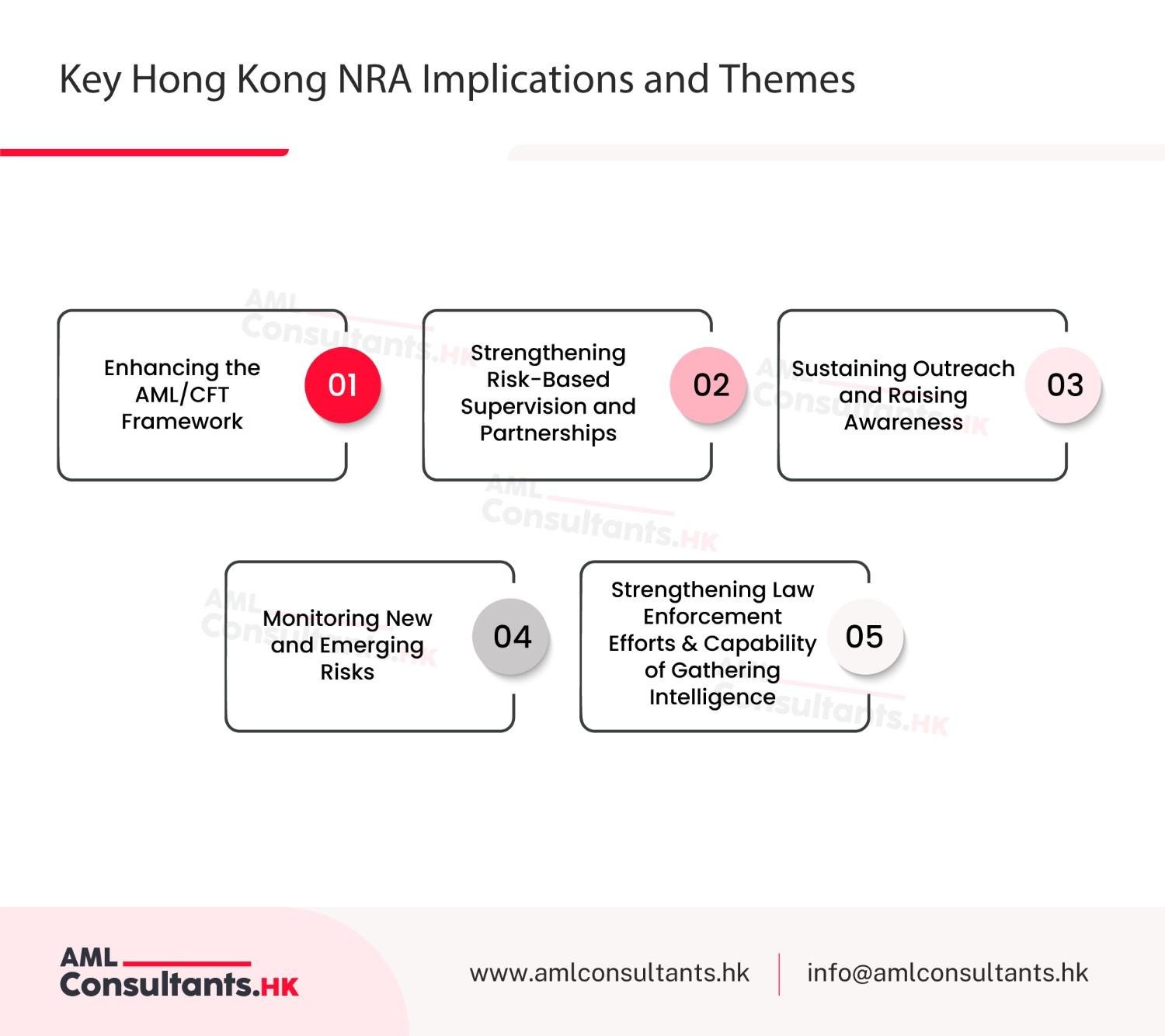
Enhancing the AML/CFT Legal Framework:
The Hong Kong authority ensures the amendment of AMLO to introduce a licensing regime for Virtual Asset Service Providers (VASPs) and a registration regime for Dealers in Precious Metals and Stones (DPMS). The AML frameworks will keep pace with international standards and adopt risk-based regulations. Further, addressing the technical issues as identified in the FATF relating to AMLO to strengthen the AML/CFT capability.
Strengthening Risk-Based Supervision and Partnerships:
Effective coordination between regulators and law enforcement agencies to identify, understand and mitigate ML/TF risks. Regulators are required to update guidelines in a timely manner and promote risk-based AML/CFT systems to meet international standards, legislative requirements and local circumstances.
The HK government encourages supervisory authorities and regulated entities to discuss typologies, trends and share intelligence. Furthermore, promotes the use of regulatory technology (RegTech) and supervisory technology (SupTech) solutions to analyse intelligence and conduct money laundering investigations.
Sustaining Outreach and Raising Awareness:
Hong Kong ML/TF National Risk Assessment involves necessary AML training for financial institutions and DNFBPs to identify high-risk patterns, ML/TF threats and detect suspicious activities. The focus is on timely updating ML/TF typologies, trends, and methods.
Monitoring New and Emerging Risks:
Hong Kong continues to monitor ML/TF risk patterns, new and emerging typologies, with the evolution of predicate offences and the development of new technologies, creating opportunities for unlawful activities.
Strengthening Law Enforcement Efforts & Capability of Gathering Intelligence:
LEAs focus on effective investigations, leverage technology and collaboration, focus on asset freezing and restraint, respond to evolving crimes, and cooperate with international authorities to combat ML/TF crimes.
The Right AML Tool Does Make a Difference.
Select the right AML software that fulfils your business operations and helps your business comply with AMLO requirements.
Hong Kong ML/TF Sector Risk Assessment (SRA)
Sector risk assessment (SRA) refers to identifying, analysing, and risk rating for a particular industry or sector. SRA includes an evaluation of the specific ML/TF and PF threats and sector vulnerabilities in Hong Kong linked to financial institutions and DNFBPs. The Hong Kong ML/TF National Risk Assessment, 2022, involves a sectoral risk assessment, which says:
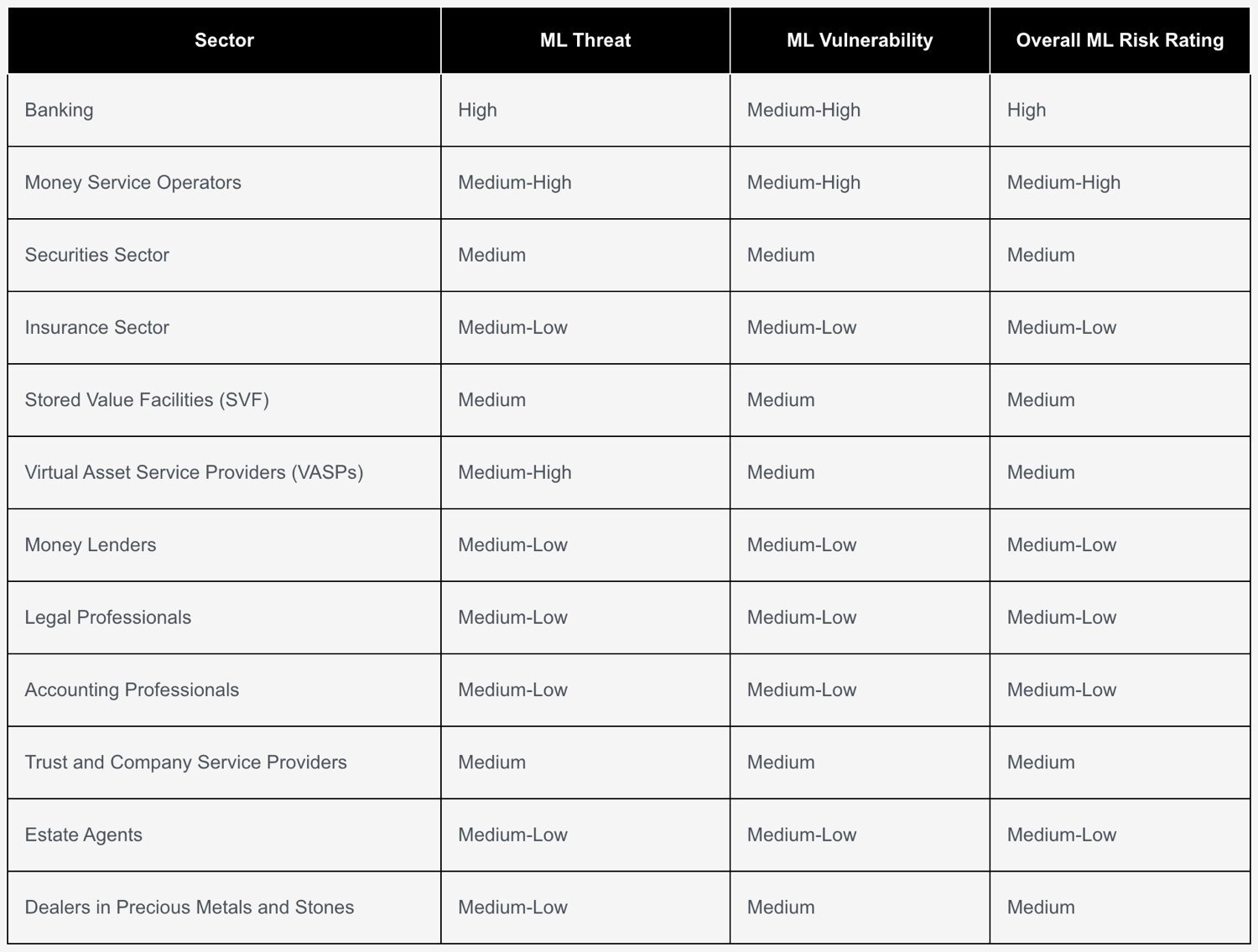
| Sector | ML Threat | ML Vulnerability | Overall ML Risk Rating |
|---|---|---|---|
| Banking | High | Medium-High | High |
| Money Service Operators | Medium-High | Medium-High | Medium-High |
| Securities Sector | Medium | Medium | Medium |
| Insurance Sector | Medium-Low | Medium-Low | Medium-Low |
| Stored Value Facilities (SVF) | Medium | Medium | Medium |
| Virtual Asset Service Providers (VASPs) | Medium-High | Medium | Medium |
| Money Lenders | Medium-Low | Medium-Low | Medium-Low |
| Legal Professionals | Medium-Low | Medium-Low | Medium-Low |
| Accounting Professionals | Medium-Low | Medium-Low | Medium-Low |
| Trust and Company Service Providers | Medium | Medium | Medium |
| Estate Agents | Medium-Low | Medium-Low | Medium-Low |
| Dealers in Precious Metals and Stones | Medium-Low | Medium | Medium |
For the Banking sector, as stated in the Hong Kong ML/TF National Risk Assessment, the significant threats are fraud, corruption & tax crimes, while risk factors include the abuse of mule accounts, remote customer onboarding, leading to overall ML risk being high.
Money Service Operators are vulnerable to cross-border fraud, hawala and cybercrime. Further, cash-intensive transactions, use of online platforms, and high volume of international transactions lead to an overall risk rating of medium-high.
The Securities sector with ML risk is medium, faces threats from social media investment scams by ramp and dump schemes and cross-border transactions. The vulnerabilities to this sector include third-party deposits or payments and the use of a nominee arrangement to disguise beneficial ownership.
The Insurance sector is exposed to ML threats on long-term insurance products and transaction threats from foreign jurisdictions, with an overall risk rating of medium-low.
For Stored Value Facilities (SVF), the overall risk rating is medium with ML threats arising from fraud, illegal bookmaking, and online payments. The ML vulnerabilities of the SVF sector include cash withdrawal and remote onboarding.
Money Lenders are primarily affected by ML threats, such as loansharking and fraud with false income documents. The ML vulnerabilities to this sector are limited, serving mostly local clients, terming the overall risk rating to be medium-low.
The Virtual Assets Service Providers (VASPs) face ML threats from fraud and theft due to their anonymous nature and lack of secure trading platforms, leading to an overall medium ML risk.
In the Hong Kong ML/TF National Risk Assessment 2022, Legal Professionals’ ML risk is described as medium-low. The sector is exposed to risks from real estate transactions and trust & company services.
The Accounting Professionals are exposed to ML threats when providing trust & company services or conducting an audit of forged documents for fraud or tax evasion. However, the high standard of professionalism leads to medium-low ML vulnerability, resulting in overall medium-low ML risk.
Trust and Company Service Providers are vulnerable to ML risks due to their services, which include forming shell or front companies. This helps criminals create complex corporate structures to hide beneficial ownership and the source of funds. Further, the diverse client base, including Politically Exposed Persons (PEPs) and High-net-worth individuals (HNWIs), also poses ML risks, with a risk rating of medium.
Estate Agents are likely less vulnerable than solicitors or banks to emerging ML risks in Hong Kong, with a risk rating of medium-low. The agents act as middlemen and handle only a small portion of the total price, merely 3-5% (rarely cash). The supervisory authority (EAA) mandates fit-and-proper tests for licensed estate agents and applies risk-based supervision.
Dealers in Precious Metals and Stones (DPMS) buy and sell high-value items exposed to ML/TF risks. However, there are very few cash transactions involved, making the ML threat rating medium-low. With statutory AML/CFT requirements not yet specifically imposed on the DPMS sector, the overall risk rating turns out to be medium.
Your Partner to Ensure Compliance, From Strategy to Practice.
We offer end-to-end AML consultancy and compliance solutions tailored to your business needs and secure the required obligations.
Nexus between NRA, SRA, EWRA, and CRA
Let’s look at how NRA, SRA, EWRA, and CRA are interlinked:
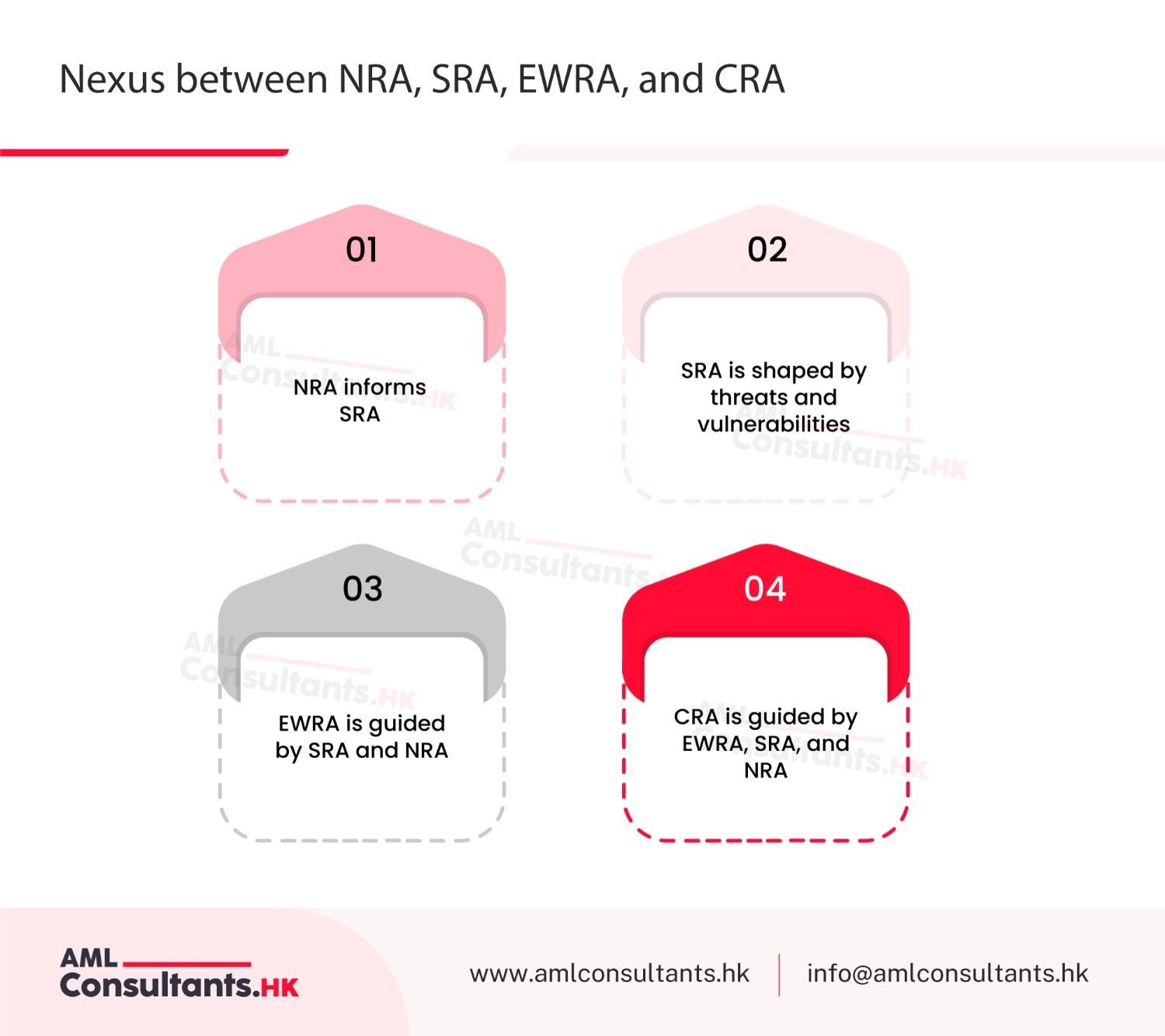
The Hong Kong Money Laundering and Terrorist Financing National Risk Assessment (NRA) provides a broader national view of ML/TF risks across sectors and helps shape the overall risk-understanding and mitigation framework.
Building on this, supervisory authorities conduct Sector Risk Assessment (SRA) to identify and assess ML/TF risks relevant to particular sectors, such as banks, insurers, estate agents, and moneylenders.
At the entity level, businesses conduct an Enterprise-Wide Risk Assessment (EWRA) by considering the findings of the NRA and the relevant SRA, and assessing their own exposure across customers, products, services, delivery channels, and geographic risk.
At the customer level, regulated entities perform a Customer Risk Assessment (CRA) to determine the appropriate level of customer due diligence and monitoring. In doing so, they rely on the EWRA outcomes, along with the sectoral and national risk context, to assess and manage the ML/TF risk associated with each customer.
How AML Consultants HK Helps Businesses in NRA Hong Kong 2022 Ensure Compliance
AML Consultants HK helps financial institutions and DNFBPs in Hong Kong comply with the strict AML regulatory framework. AML Consultants HK ensure alignment with the NRA and SRA findings while conducting Enterprise-Wide Risk Assessment for businesses.
Further, the AML Consultants HK helps in AML Software Selection (RegTech solutions) to implement Customer Due Diligence and monitoring, as encouraged by the NRA HK 2022. Moreover, they also offer a thorough Health Check to identify gaps in compliance and meet regulatory expectations.
Risk is Everywhere, Know Exactly Your Business ML Vulnerabilities.
We design custom EWRA to help you detect the unseen risk and protect your business from unpredictable threats.
FAQs on Hong Kong ML/TF NRA
Why does Hong Kong conduct a national risk assessment for ML and TF?
Hong Kong ML/TF national risk assessment is conducted to ensure compliance with FATF standards and identify, analyse and understand the city’s ML/TF risk exposure to implement risk-based mitigation measures.
Which authority is responsible for Hong Kong’s ML/TF National Risk Assessment?
The Hong Kong ML/TF National Risk Assessment is conducted through a multi-agency approach by the Central Coordinating Committee, headed by the Financial Services and the Treasury Bureau (FSTB).
How often does Hong Kong update its National Risk Assessment on financial crime?
Hong Kong updates the NRA on financial crime periodically, with the latest reports published in 2022, to implement mitigation measures on the basis of the updated assessment results.
How does the National Risk Assessment influence AML/CFT policies in Hong Kong?
The National Risk Assessment shapes AML/CFT policies by identifying ML/TF typologies and risks, enabling a tailored, risk-based approach in Hong Kong for AML compliance and combating money laundering and terrorist financing.
How does Hong Kong’s National Risk Assessment align with FATF recommendations?
The Hong Kong ML/TF National Risk Assessment is prepared in accordance with Financial Action Task Force (FATF) requirements and examines the ML/TF threats and vulnerabilities specific to each sector in Hong Kong, and also assesses PF risks faced by HK for the first time.
About the Author

Pathik Shah
Founder | FCA, CAMS, CISA, CS, DISA (ICIAI), FAFP (ICAI)
Pathik Shah is a Chartered Accountant with more than 28 years of experience working at the juncture of governance, compliance, and financial risk. His work has consistently focused on helping institutions in Hong Kong to operate confidently within regulated environments, particularly where AML/CFT obligations demand practical implementation.
As part of his role with AML Consultants HK, Pathik is involved in working with various financial institutions and DNFBPs so that not only are their AML frameworks compliant from a regulatory standpoint under the Anti-Money Laundering and Counter-Terrorist Financing Ordinance (Cap. 615), but they are also effective from a supervisory review expectations standpoint. Aside from that, Pathik has served as a functional expert in the development and deployment of RegTech solutions to enhance monitoring discipline and documentation integrity. Additionally, he has assisted institutions in understanding the FATF requirements and how to implement them within the Hong Kong context in an operationally feasible manner.
Pathik is a recognised thought leader in AML/CFT and frequently shares insights on trends in financial crime risks and developing supervisory approaches on various platforms.

Reach Out to Pathik
