


Table of Contents
- March 19, 2026
- Pathik Shah
Key Highlights: AML/CFT Regulatory Framework for DNFBPs
- The core AML/CFT regulatory framework for DNFBPs in Hong Kong includes AMLO, DTROP, UNAMTO, OSCO, WMDO, IEO, and UNSO.
- With this, the sector-specific ordinances include the legal practitioner ordinance, the estate agent ordinance, and the professional accountant ordinance.
- Each DNFBP sector is regulated by a different supervisory authority, including the Law Society of Hong Kong, Hong Kong Institute of Certified Public Accountants, Estate Agents Authority, Companies Registry, and the Customs and Excise Department.
- The National Risk Assessment report states ML/TF and PF threats and vulnerabilities for each sector and provides risk-based guidance on each sector.
Core AML/CFT Ordinances Applicable to DNFBPs
To understand the AML/CFT compliance obligations of DNFBPs, it is important to know the key AML/CFT laws that apply to them. The following is the AML/CFT regulatory framework for DNFBPs in Hong Kong:
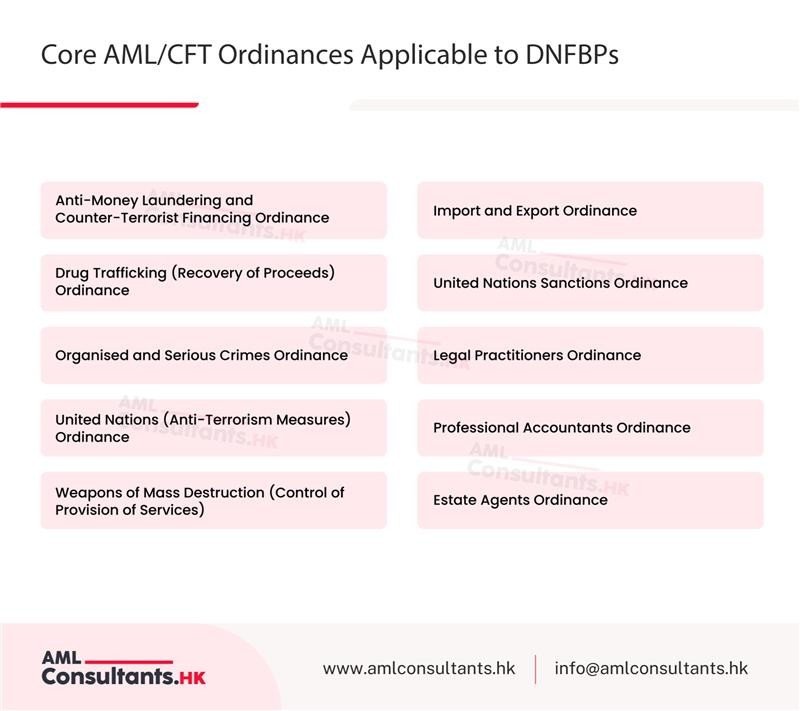
Anti-Money Laundering and Counter-Terrorist Financing Ordinance (AMLO), Cap. 615
The AMLO is the primary legal framework that governs the AML programme in Hong Kong for DNFBPs. As of March 1, 2018, AMLO, Schedule 2, mandates that DNFBPs implement Customer Due Diligence and record-keeping for 5 years.
Drug Trafficking (Recovery of Proceeds) Ordinance (DTROP), Cap. 405
The DTROP is designed for DNFBPs to seize, trace, and confiscate assets obtained from illegal drug activities. The framework mandates DNFBPs to disclose the knowledge or suspicion of the proceeds of drug trafficking to an authorised officer, and they must not deal with such criminal property. Further, the ordinance mentions ‘tipping off’ as an offence and imposes severe penalties on DNFBPs who disclose information about STR decision-making.
Organised and Serious Crimes Ordinance (OSCO), Cap. 455
OSCO targets organised crime and money laundering, and requires DNFBPs to submit a Suspicious Transaction Report (STR) for knowledge or suspicion of criminal activity.
United Nations (Anti-Terrorism Measures) Ordinance (UNATMO), Cap. 575
UNATMO aims to prevent terrorism and forbids DNFBPs from being involved in financing terrorist activities. This AML/CFT regulatory framework for DNFBPs mandates freezing funds or assets relating to terrorists or their associates.
Weapons of Mass Destruction (Control of Provision of Services) Ordinance (WMDO), Cap. 526
WMDO prohibits services that lead to the development, production or acquisition of weapons of mass destruction and requires DNFBPs to perform adequate due diligence to ensure their customers are not linked to the development of such weapons.
Import and Export Ordinance (IEO), Cap. 60
The IEO restricts DNFBPs from engaging in transactions that involve the import and export of certain goods (strategic commodities), such as dual-use goods and sensitive technologies, without government approval or a license. DNFBPs involved in such trade transactions must verify the clients’ identities and should not facilitate transactions for clients engaged in illegal import/export of strategic commodities.
United Nations Sanctions Ordinance (UNSO), Cap. 537
UNSO mandates sanctions on individuals and entities designated by the United Nations Security Council and requires DNFBPs not to be involved in any business relationship with sanctioned individuals.
Legal Practitioners Ordinance (LPO), Cap. 159
LPO, the regulatory ordinance governing lawyers and legal professionals, provides the qualification and admission requirements for these DNFBPs to practice law in Hong Kong. It requires them to possess practising certificates and empowers the Law Society of Hong Kong to regulate and enforce professional standards. The LPO ordinance also interfaces with the AMLO and defines who the lawyer is, and AMLO specifies AML/CFT obligations of the legal practitioners.
Professional Accountants Ordinance, Cap. 50
This ordinance on DNFBPs regulates professional accountants in Hong Kong and requires them to register to be recognised as Certified Public Accountants (CPA). The Professional Accountants Ordinance, Cap. 60, also interfaces with the AMLO and defines who the professional accountant is, and AMLO specifies AML/CFT obligations of the professional accountants.
Estate Agents Ordinance, Cap. 511
This ordinance for DNFBPs governs estate agents, mandates their licensing and professional standards to carry out business. The estate agents ordinance, Cap. 511, also interfaces with the AMLO and defines who the estate agent is, and AMLO specifies AML/CFT obligations of the estate agents.
Bring Regulatory Requirements into Practice.
Ensure that you meet customer due diligence requirements without fail and remain compliant with AMLO.
AML/CFT Supervisory Authorities for DNFBPs in Hong Kong
Each DNFBP sector in Hong Kong is supervised by a distinct authority. The following are AML/CFT Supervisory Authorities for DNFBPs in Hong Kong:
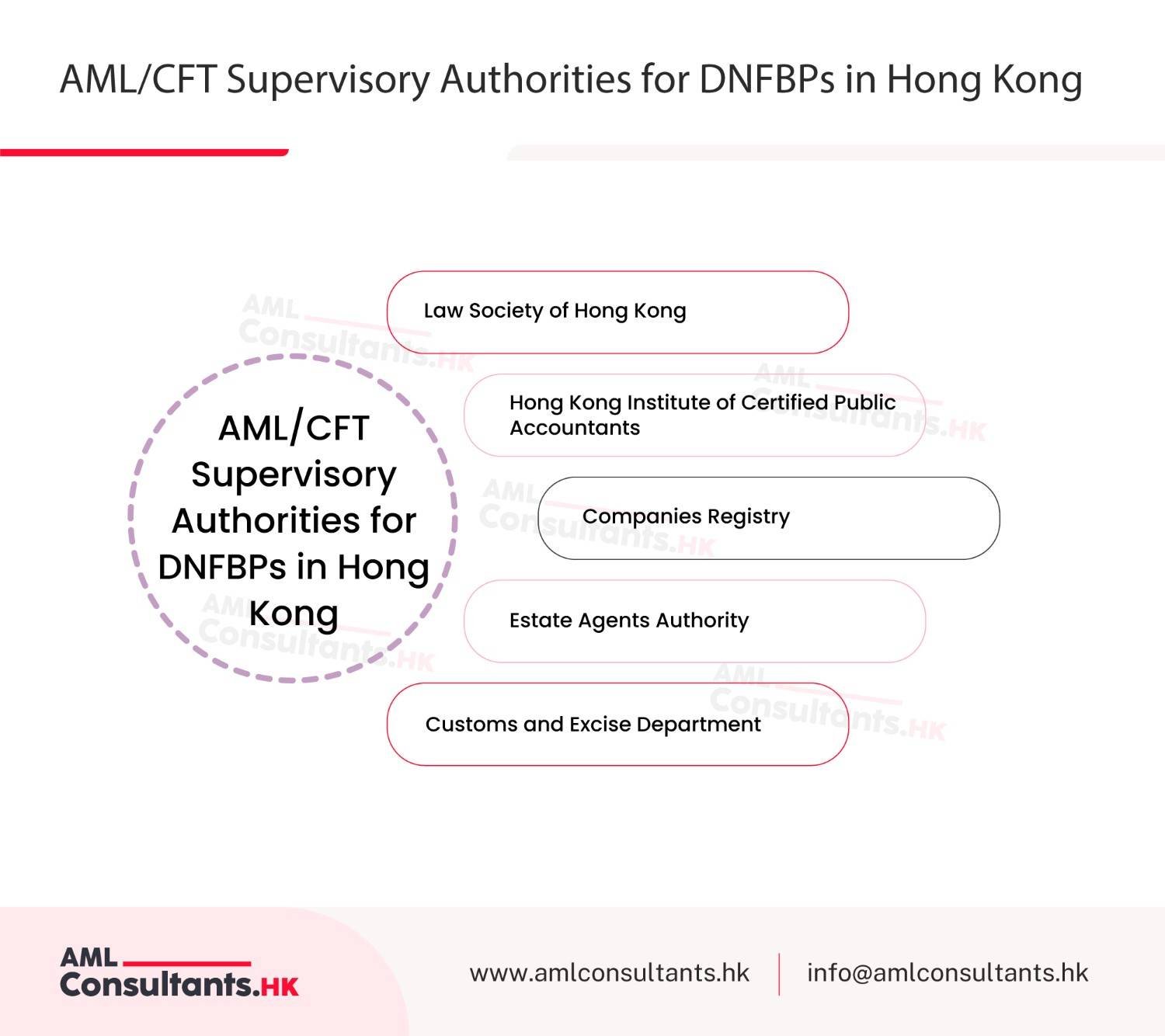
Law Society of Hong Kong
The Law Society of Hong Kong (LSHK) was established in 1907 to supervise DNFBPs, primarily the law firms and solicitors in Hong Kong. The authority helps these legal professionals to detect and prevent ML/TF and PF risks and comply with AMLO statutory requirements.
Hong Kong Institute of Certified Public Accountants
The Hong Kong Institute of Certified Public Accountants (HKICPA) supervises accounting professionals and registered accountants, who are commonly considered DNFBPs in Hong Kong. It further issues guidelines for these professionals to comply with the AMLO standards in Hong Kong.
Companies Registry
The Trust or Company Service Providers are regulated by the Companies Registry (CR) in Hong Kong, which mandates compliance with the AML/CFT regulatory framework for DNFBPs. The CR provides licenses to TCSPs and requires them to pass the fit-and-proper test.
Estate Agents Authority
The Estate Agents Authority (EAA) was established in 1997 and regulates the specific segment of DNFBPs designated as real estate sector agents in Hong Kong. The authority ensures the estate agents comply with AML/CFT obligations.
Customs and Excise Department
The Customs and Excise Department regulates the AML/CFT conduct of Dealers in Precious Metals and Stones (DPMS), acting as DNFBPs in Hong Kong. The authority mandates registration under the Commissioner of Customs and Excise.
AML/CFT Law Enforcement Agencies and FIU Overview
The law enforcement agencies (LEAs) in Hong Kong investigate financial crime and maintain national security. Also, the LEAs enforce compliance with the AML/CFT regulatory framework for DNFBPs, such as AMLO. The following are the known LEAs and FIU in Hong Kong:
Does Your Compliance Team Comprehend AML/CFT Legal Requirements?
We provide staff training to ensure compliance with AMLO Schedule 2 CDD and record-keeping requirements.
Hong Kong AML/CFT NRA Implications for DNFBPs
The 2022 AML/CFT National Risk Assessment (NRA) for Hong Kong mentions the AML/CFT regulatory framework for DNFBPs. It further highlights the need to enhance control measures to combat money laundering and terrorist financing. The following states the NRA implications for Designated Non-Financial Businesses and Professions (DNFBPs) in Hong Kong:
Legal Professionals
Legal professionals categorised as solicitors and barristers, with medium-low ML risks, face significant ML threats when providing trust or company services and processing real estate transactions. Further, high professional integrity and strong entry controls mitigate ML vulnerabilities. Legal professionals are required to take risk-based controls to mitigate ML, TF, and PF risks.
Estate Agents
Estate agents face medium-low ML risks as they are not generally considered part of the actual fund-flow chain and only transact the initial deposits involved in real estate purchases or sales. Also, the Estate Agents Authority applies strict risk-based supervision on estate agents to mitigate the ML/TF exposure, which reduces the ML vulnerabilities. Estate agents are required to take risk-based controls to mitigate ML, TF, and PF risks.
Trust or Company Service Providers (TCSPs)
TCSPs labelled as medium ML risk are largely involved in the formation of shell/front companies, which are mostly misused by criminals for layering. Also, the sector is exposed to risk from a diverse client base, including high-net-worth individuals and Politically Exposed Persons (PEPs). Furthermore, the NRA 2022 mentions the requirement for TCSPs to apply for licences under the Companies Registry and must pass the fit-and-proper test. TCSPs are required to take risk-based controls to mitigate ML, TF, and PF risks.
Dealers in Precious Metals and Stones (DPMS)
The DPMS sector has a medium ML risk rating as it deals with high-value items, which are likely to be converted from crime proceeds. Further, the HK NRA 2022 addresses the introduction of a new registration regime for DPMS as overseen by the Commissioner of C&ED. Dealers in Precious Metals and Stones are required to take risk-based controls to mitigate ML, TF, and PF risks.
Accounting Professionals
Accountants have a medium-low ML risk with the sector’s effective monitoring programs and compliance culture. The sector faces ML threats when criminals use innocent agents to audit forged documents. Accounting professionals are required to take risk-based controls to mitigate ML, TF, and PF risks.
How to Use This Guide
Get a thorough overview of supervisory authorities, AML/CFT regulatory framework for DNFBPs and their compliance requirements.
| Supervisory Authority | Supervises | Legal Framework | Compliance Requirements |
|---|---|---|---|
| Customs and Excise Department (C&ED) | Dealers in Precious Metals and Stones (DPMS) | AML/CFT Legal Framework for DPMS Sector in Hong Kong | AML/CFT Compliance Requirements for the DPMS Sector in Hong Kong |
| Law Society of Hong Kong | Legal Professionals | AML/CFT Legal Framework for Legal Professionals in Hong Kong | AML/CFT Compliance Requirements for Legal Professionals in Hong Kong |
| Hong Kong Institute of Certified Public Accountants | Accounting Professionals | AML/CFT Legal Framework for Accounting Professionals in Hong Kong | AML/CFT Compliance Requirements for Accounting Professionals in Hong Kong |
| Estate Agents' Authority | Estate Agents | AML/CFT Legal Framework for Estate Agents in Hong Kong | AML/CFT Compliance Requirements for Estate Agents in Hong Kong |
| Companies Registry | Trust or Company Service Providers (TCSPs) | AML/CFT Legal Framework for TCSPs in Hong Kong | AML/CFT Compliance Requirements for TCSPs in Hong Kong |
Strong Systems Help Spot Risks Faster.
We help design AML/CFT systems that demonstrate adherence to Hong Kong AML/CFT regulatory frameworks for DNFBPs.
How AML Consultants HK Helps in Implementing Legal Framework for DNFBPs in Hong Kong
AML Consultants HK helps DNFBPs to comply with AMLO and other legal frameworks in Hong Kong. AML Consultants HK helps DNFBPs fulfil KYC/CDD requirements, including beneficial ownership verification and develop customer risk profiles.
Further, the AML Consultants HK supports DNFBPs in designing and strengthening the AML/CFT systems that meet statutory obligations. Moreover, the AML Consultants HK provides AML/CFT training that helps fight financial crimes more effectively.
FAQs on AML/CFT Regulatory Framework for DNFBPs
Who is included in DNFBPs in Hong Kong?
The DNFBPs include legal professionals, estate agents, Trust or Company Service Providers (TCSPs), accountants, and Dealers in Precious Metals and Stones (DPMS).
What are DNFBPs under Hong Kong’s AML/CFT framework?
In Hong Kong, DNFBPs are non-financial institutions that are mandated to comply with the AMLO, Cap. 615 requirements and prevent money laundering and terrorist financing.
What AML/CFT obligations apply to DNFBPs in Hong Kong?
DNFBPs in Hong Kong must comply with the AMLO obligations that mandate conducting Customer Due Diligence (CDD), ongoing monitoring, and record-keeping. Further, the other obligations include suspicious transactions reporting and sanctions screening.
Are lawyers and accountants considered DNFBPs under Hong Kong AML laws?
Yes, lawyers that include solicitors and other law firms, and accounting professionals, are considered DNFBPs under the Hong Kong AML laws. They act as gatekeepers, report suspicious transactions, and help control ML/TF/PF risks in Hong Kong.
About the Author

Pathik Shah
Founder | FCA, CAMS, CISA, CS, DISA (ICIAI), FAFP (ICAI)
Pathik Shah is a Chartered Accountant with more than 28 years of experience working at the juncture of governance, compliance, and financial risk. His work has consistently focused on helping institutions in Hong Kong to operate confidently within regulated environments, particularly where AML/CFT obligations demand practical implementation.
As part of his role with AML Consultants HK, Pathik is involved in working with various financial institutions and DNFBPs so that not only are their AML frameworks compliant from a regulatory standpoint under the Anti-Money Laundering and Counter-Terrorist Financing Ordinance (Cap. 615), but they are also effective from a supervisory review expectations standpoint. Aside from that, Pathik has served as a functional expert in the development and deployment of RegTech solutions to enhance monitoring discipline and documentation integrity. Additionally, he has assisted institutions in understanding the FATF requirements and how to implement them within the Hong Kong context in an operationally feasible manner.
Pathik is a recognised thought leader in AML/CFT and frequently shares insights on trends in financial crime risks and developing supervisory approaches on various platforms.

Reach Out to Pathik
