


Table of Contents
- March 18, 2026
- Pathik Shah
Key Takeaways – Law Enforcement, Investigation and FIU Reporting Agencies in Hong Kong
- Hong Kong AML Law Enforcement Agencies investigate money laundering, trace proceeds of crime, and enforce the Anti-Money Laundering and Counter-Terrorist Financing Ordinance (AMLO).
- The key LEAs include the Hong Kong Police Force, the Customs and Excise Department, the Independent Commission Against Corruption and the Joint Financial Intelligence Unit.
- The LEAs collaborate to manage intelligence, detect suspicious transactions and combat financial crime.
What AML/CFT Law Enforcement Agencies in Hong Kong Focus On
Hong Kong has designated AML/CFT law enforcement agencies equipped with powers to investigate, freeze, seize and confiscate money laundering (ML) and terrorist financing (TF) offences. The AML/CFT law enforcement agencies in Hong Kong are known for their integrity, effectiveness and compliance with the AML/CFT laws. Hong Kong AML/CFT Law Enforcement Agencies, the Hong Kong Police Force (HKPF) and the Customs and Excise Department (C&ED) primarily conduct ML investigations, while the Independent Commission Against Corruption (ICAC) investigates corruption-related crimes. Moreover, the Joint Financial Intelligence Unit (JFIU) is a central repository responsible for handling suspicious transaction reporting in HK.
List of AML/CFT Law Enforcement Agencies in Hong Kong
The following are the Hong Kong AML law enforcement agencies (LEAs) that work with the governmental bodies and supervisory authorities to combat ML/TF risks:
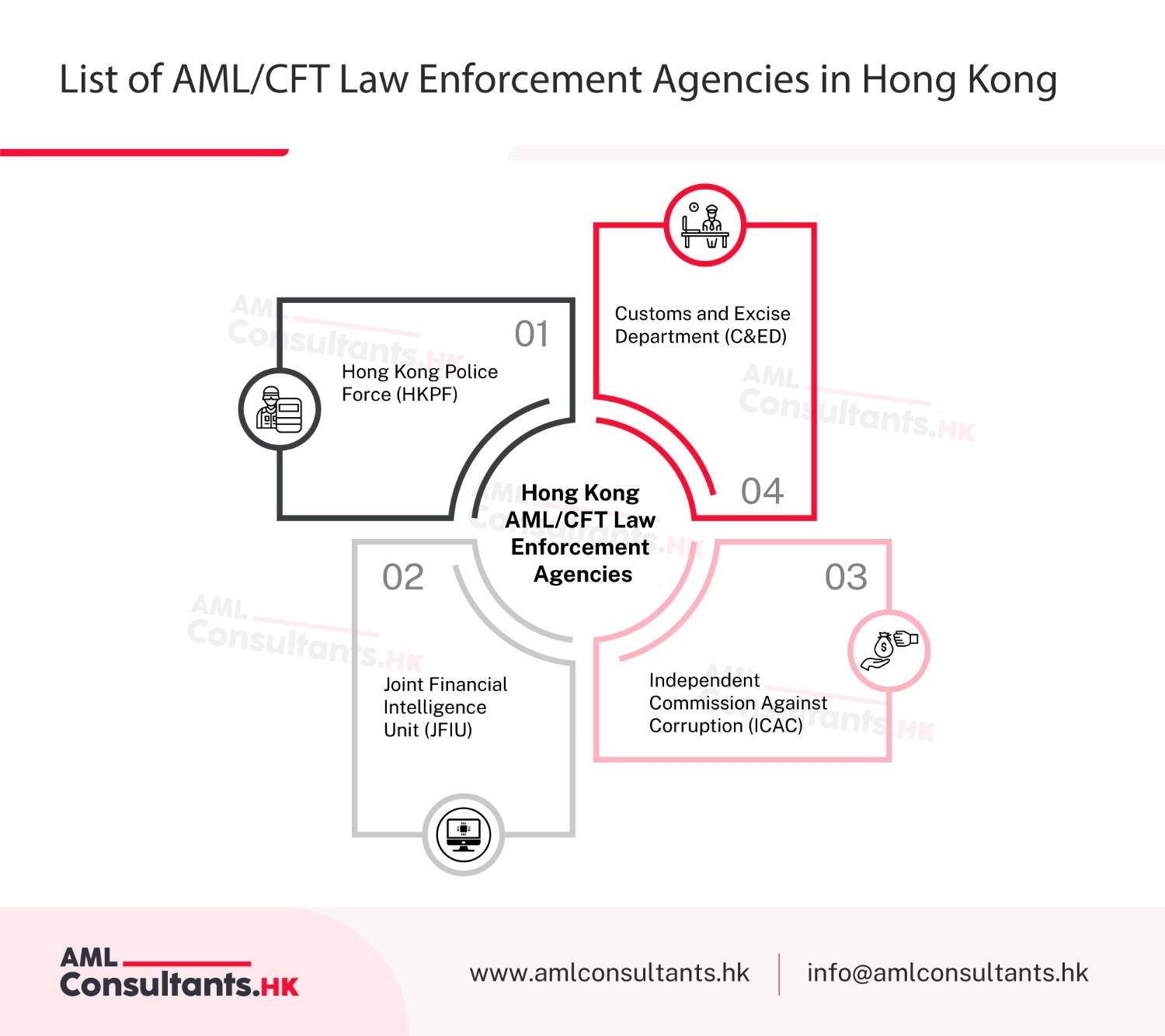
Hong Kong Police Force (HKPF)
HKPF is one of the primary Hong Kong AML/CFT law enforcement agencies under the Security Bureau and is responsible for preserving law, order and national security. The agency has a specialised bureau called the Financial Intelligence and Investigation Bureau (FIIB), established on June 1, 2021, dedicated to terrorist financing and money laundering investigations in HK.
Customs and Excise Department (C&ED)
Customs and Excise Department (C&ED) is a primary LEA and key supervisory authority for AML/CFT in Hong Kong. C&ED supervises Money Service Operators (MSOs) and Dealers in Precious Metals and Stones (DPMS), ensuring entities meet AML/CFT compliance requirements. Further, C&ED investigates ML/TF cases, especially linked to customs-related crime, seizes and freezes assets and takes over proceeds of crime.
Independent Commission Against Corruption (ICAC)
The Independent Commission Against Corruption (ICAC) in Hong Kong is a known AML/CFT Law Enforcement Agency (LEA), primarily dedicated to combating ML/TF crimes facilitated by corruption. The ICAC, established on February 15, 1974, fights corruption through a three-pronged strategy – education, prevention, and law enforcement. The agency also has a special unit that restrains and confiscates the proceeds of crime.
Joint Financial Intelligence Unit (JFIU)
The Joint Financial Intelligence Unit (JFIU), established in 1989, is staffed by joint personnel from the HKPF and C&ED. The JFIU’s role in Hong Kong includes receiving, analysing, and disseminating Suspicious Transaction Reports (STRs) to relevant authorities. Further, JFIU identifies common ML/TF typologies and emerging risks.
Smarter Teams Build Stronger Compliance.
Equip staff with effective AML training that helps detect ML/TF risks early.
STR Lifecycle and Documentation in Hong Kong
The Suspicious Transaction Report (STR) follows a comprehensive process, called the SAFE approach, that ensures AML/CFT legal compliance and ML investigations. The STR reporting flow in Hong Kong goes as follows:
Screen: Recognise the red flags or suspicious activity indicators.
Ask: Staff must ask the customer relevant questions when their activities or transactions appear suspicious.
Find: Regulated Entities should review existing customer records and known information to determine whether the identified behaviour is truly suspicious.
Evaluate: Lastly, entities should analyse all the information gathered and decide whether to complete an STR.
STR must be filed when entities have suspicion or knowledge of money laundering or terrorist financing crimes to an authorised officer (JFIU) as soon as it is practicable. Further, the documentation includes personal particulars, activity details, reason for suspicion and customer explanation of the transaction.
Regulated entities must submit STR through the STREAMS 2 electronic system. Entities other than the regulated entities can submit the STR Proforma by email to JFIU.
STR is a primary tool which enables Hong Kong AML/CFT Law Enforcement Agencies to counter money laundering and terrorist financing.
How to Protect Privilege and Confidentiality
The obligation to submit STR overrides the clients’ rights to confidentiality. This means that the submission of STR to the JFIU is not a breach of client confidentiality, and the person making the report cannot be sued for privacy breaches and damages.
The JFIU keeps reports confidential and handles them on a “need to know” basis. Regulated entities must not provide information to customers about STR filing, as under DTROP and OSCO, it’s an offence to publish or broadcast information revealing STR.
How AML Consultants HK Helps Meet Reporting Requirements in Hong Kong
AML Consultants HK helps regulated entities design AML/CFT systems that involve documented policies & procedures for filing STRs. AML Consultants HK provides staff AML/CFT training about detecting unusual transaction patterns and suspicious activity to meet the expectations of Hong Kong AML law enforcement agencies and ensure compliance with AMLO obligations. Additionally, AML Consultants HK provides AML regulatory reporting support that includes preparing suspicious transaction reports and submitting them to JFIU through the STREAMS 2 system.
Suspicious Transaction? Report It Right.
Our AML experts understand the unusual patterns in transactions and help you with accurate STR submission.
FAQs on Hong Kong AML Law Enforcement Agencies
What are the law enforcement agencies in Hong Kong for AML?
Hong Kong law enforcement agencies include the Hong Kong Police Force (HKPF), Customs and Excise Department (C&ED), Independent Commission Against Corruption (ICAC), and the Joint Financial Intelligence Unit (JFIU), which investigates and prevents ML/TF crimes.
How does the Hong Kong Police Force investigate money laundering cases?
The Hong Kong Police Force has a specialised unit, the Financial Intelligence and Investigation Bureau (FIIB), that investigates money laundering cases and handles financial crimes.
What role does the Customs and Excise Department play in AML enforcement in Hong Kong?
The Customs & Excise Department (C&ED) in Hong Kong is a law enforcement agency that investigates, seizes, freezes, and confiscates terrorist property and the proceeds of crime.
How do Hong Kong AML law enforcement agencies handle suspicious transaction reports?
The JFIU receives STRs from regulated entities, analyses them and disseminates reports concerning potential ML/TF activities.
How do Hong Kong authorities cooperate internationally to combat money laundering and terrorist financing?
Hong Kong AML law enforcement agencies, such as JFIU, HKPF, ICAC, C&ED, and other competent authorities, meet periodically, exchange financial intelligence and review ML/TF typologies and trends to combat ML/TF activities.
Build AML/CFT Systems That Regulators Trust.
We design AML policies and procedures that help meet the expectations of law enforcement agencies and regulators.
About the Author

Pathik Shah
Founder | FCA, CAMS, CISA, CS, DISA (ICIAI), FAFP (ICAI)
Pathik Shah is a Chartered Accountant with more than 28 years of experience working at the juncture of governance, compliance, and financial risk. His work has consistently focused on helping institutions in Hong Kong to operate confidently within regulated environments, particularly where AML/CFT obligations demand practical implementation.
As part of his role with AML Consultants HK, Pathik is involved in working with various financial institutions and DNFBPs so that not only are their AML frameworks compliant from a regulatory standpoint under the Anti-Money Laundering and Counter-Terrorist Financing Ordinance (Cap. 615), but they are also effective from a supervisory review expectations standpoint. Aside from that, Pathik has served as a functional expert in the development and deployment of RegTech solutions to enhance monitoring discipline and documentation integrity. Additionally, he has assisted institutions in understanding the FATF requirements and how to implement them within the Hong Kong context in an operationally feasible manner.
Pathik is a recognised thought leader in AML/CFT and frequently shares insights on trends in financial crime risks and developing supervisory approaches on various platforms.

Reach Out to Pathik
