


Table of Contents
- May 19, 2026
- Pathik Shah
AML Laws for Accounting Professionals in Hong Kong- Key Takeaways
- The key AML Laws for accounting professionals in Hong Kong include AMLO, DTROP, OSCO, UNATMO, WMDO, UNSO, and PAO.
- Under AMLO, both the Accounting and Financial Reporting Council (AFRC) and the Hong Kong Institute of Certified Public Accountants (HKICPA) are designated as regulatory bodies for accounting professionals.
- The AFRC conducts inspections, while the HKICPA issues guidance on the CDD and record-keeping requirements.
- The LEAs and FIUs for the accounting professionals include HKPF, C&ED, ICAC, and JFIU.
- AML Consultants HK helps in implementing the AML Laws for accounting professionals in Hong Kong by providing staff training, performing AML health checks, and supporting regulatory reporting.
AMLO: Scope and Applicability for Accounting Professionals in Hong Kong
The AML Laws for accounting professionals in Hong Kong includes key ordinances, regulatory guidance, and supervisory authorities.
The framework is applicable to accounting professionals, including certified public accountants, accounting firms, and corporate practices engaged in providing accounting and related financial services.
As per Hong Kong AML for accountants, Accounting professionals are regulated by the Accounting and Financial Reporting Council (AFRC), alongside the Hong Kong Institute of Certified Public Accountants (HKICPA).
Accounting professionals are legally classified as DNFBPs under AMLO and are required to conduct accounting professional CDD, including beneficial ownership verification, ongoing monitoring, and record-keeping.
Non-compliance with the AML Laws for accounting professionals in Hong Kong will result in legal, regulatory, and reputational risks, including professional disciplinary actions, fines, and imprisonment.
AML/CFT Laws and Regulations Applicable to Accounting Professionals in Hong Kong
The AML Laws for accounting professionals in Hong Kong are as follows:
Laws Applied to Accounting Professionals
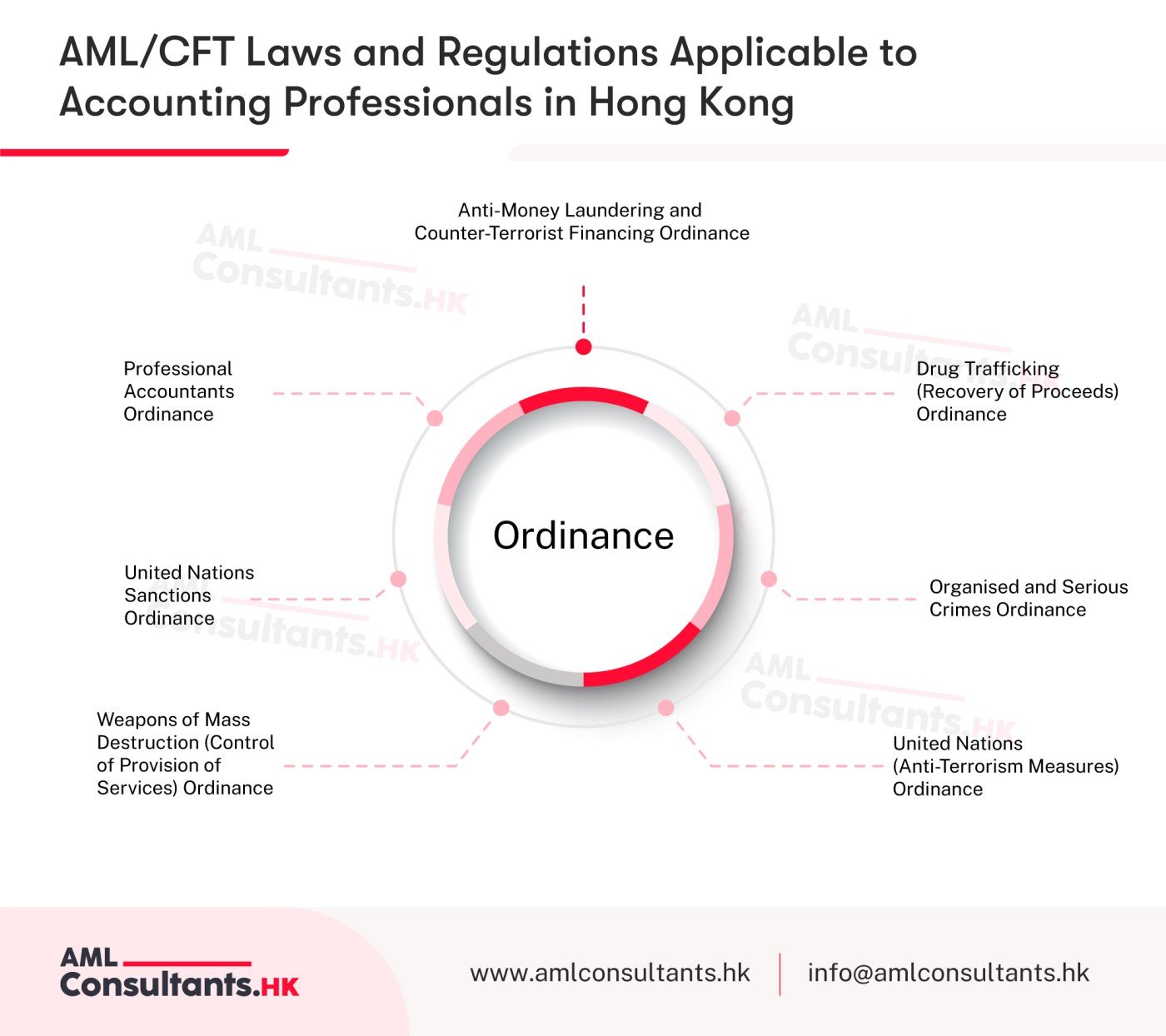
- Anti-Money Laundering and Counter Terrorist Financing Ordinance (AMLO)
AMLO is the law in Hong Kong that mandates accounting professionals to perform customer due diligence and maintain records. - Drug Trafficking (Recovery of Proceeds) Ordinance
DTROP is a law that prohibits accounting professionals from dealing with property known or suspected to be the drug proceeds and also requires them to report suspicious transactions to the JFIU. - Organised and Serious Crimes Ordinance (OSCO)
OSCO makes it an offence for accounting professionals to deal with proceeds linked with organised and serious crime, and it also enables asset restraint and confiscation linked with such crime. - United Nations (Anti-Terrorism Measures) Ordinance (UNATMO)
UNATMO is a law that is designed to follow the United Nations rules to prevent and stop terrorism. It prohibits any person, including accounting professionals, from providing property or financial services to support terrorism and requires them to disclose the suspicious activity linked to terrorism. - Weapons of Mass Destruction (Control of Provision of Services) Ordinance (WMDO)
WMDO is a law in Hong Kong that restricts individuals and professionals, including accounting professionals, from providing services that may assist the development, production, or acquisition of weapons capable of causing mass destruction. - United Nations Sanctions Ordinance (UNSO)
UNSO is the law in Hong Kong that requires accounting professionals to comply with UN-imposed sanctions, ensuring that they do not facilitate transactions with such individuals, entities, or jurisdictions, and are also required to implement screening controls. - Professional Accountants Ordinance
This ordinance governs professional accountants, ensuring that they follow professional standards and ethics, and it also mandates them to conduct customer due diligence and maintain proper records.
Train your Team to Detect ML/TF Risks
We help in equipping your accounting staff with practical AML/CFT training to mitigate the ML/TF risk exposure.
AML/CFT Guidelines Applicable to Accounting Professionals in Hong Kong
Guidelines on Anti-Money Laundering and Counter-Terrorist Financing for Professional Accountants (May 2023) is published under section 7 (1) of AMLO and is part of the Code of Ethics for Professional Accountants. These guidelines replace the Guidelines under Government Notice No. 1225 in Gazette No. 8 Volume 22, published in February 2018.
The Hong Kong Institute of Certified Public Accountants takes responsibility for publishing and amending these guidelines, which apply to practices and institute members working in practices and to responsible persons, who are accounting professionals.
Accounting professionals’ AML guidelines require them to implement customer due diligence, ongoing monitoring, and record-keeping. Non-compliance may result in criminal prosecutions, fines, and reputational damage.
When Do the Guidelines on AML/CTF for Professional Accountants Apply?
Guidelines on Anti-Money Laundering and Counter-Terrorist Financing for Professional Accountants, May 2023, require specific customer due diligence, ongoing monitoring, and record-keeping obligations when a practice provides certain services as part of its business.
Covered services include:
- buying or selling real estate
- managing client money, securities, or other assets
- managing bank, savings, or securities accounts
- arranging contributions for the creation or management of corporations
- creating, operating, or managing legal persons or legal arrangements
- buying or selling business entities
Additional customer due diligence, ongoing monitoring, and record-keeping obligations apply where a practice provides trust or company services as part of its business.
Covered services include:
- forming corporations or other legal persons
- acting as, or arranging another person to act as, a company director, company secretary, partnership partner, or a similar position in another legal person
- providing a registered office, business address, correspondence address, or administrative address for a corporation, partnership, legal person, or legal arrangement
- acting as, or arranging another person to act as, a trustee of an express trust or similar legal arrangement
- acting as, or arranging another person to act as, a nominee shareholder, except where the shares are in a corporation listed on a recognised stock market
AML/CFT Regulatory Authorities for Accounting Professionals in Hong Kong
The Accounting and Financial Reporting Council (AFRC) is the main regulatory authority for accounting professionals in Hong Kong, as of October 1, 2022. The role of AFRC is to handle the registration of audit practitioners and firms, and to supervise accounting professionals to ensure that they follow the AML/CFT law and standards.
The Hong Kong Institute of Certified Public Accountants (HKICPA) is the professional body that works alongside AFRC, and the main role of HKICPA includes issuing guidelines, setting professional ethics, and providing required training to accounting professionals to comply with AML/CFT rules.
AFRC vs HKICPA
| Feature | AFRC (The Regulator) | HKICPA (The Professional Body) |
|---|---|---|
| Primary Status | Independent Statutory Body | Professional Membership Body |
| Core Mission | Public interest and regulatory oversight | Professionalism and industry growth |
| AML Guidelines | Oversees and enforces compliance | Drafts and updates the Guidelines |
| Registration | CPA Firms and PIE Auditors | Individual CPAs (Membership) |
| Inspections | Conducts “Compliance Monitoring” | No longer performs practice reviews |
| Discipline | Imposes fines, reprimands, and bans | Refers misconduct cases to the AFRC |
| Training | Sets high-level CPD requirements | Provides the actual CPD and training |
Identify Gaps Before Regulators Do
Our AML health check pinpoints weaknesses in your framework and delivers a clear, actionable roadmap to comply with AML/CFT requirements in Hong Kong.
AML/CFT Law Enforcement Agencies in the Accounting Professionals Sector
AML/CFT law enforcement agencies under the AML Laws for accounting professionals in Hong Kong include:
- Hong Kong Police Force (HKPF)
- Customs and Excise Department (C&ED)
- Independent Commission Against Corruption (ICAC)
Financial Intelligence Unit (FIU)in Hong Kong
Hong Kong Joint Financial Intelligence Unit (JFIU) is the financial intelligence unit, jointly operated by HKPF and C&ED, and it is the agency managing the suspicious transaction reporting under the Hong Kong AML/CFT regime.
Hong Kong NRA, SRA, and Risks Associated with Accounting Professionals
The Hong Kong National Risk Assessment (NRA) and Sectoral Risk Assessment (SRA) provide a comprehensive overview of ML/TF/PF risks associated with accounting professionals.
- ML Risk (medium-low)
As per the Hong Kong NRA July 2022, the money laundering risk associated with accounting professionals is medium-low due to their threats and vulnerabilities, including: - ML Threats (medium-low)
Accounting professionals have medium-low threats to ML/TF as they are primarily exposed through TCSPs and may act as “innocent agents”, where criminals use forged documents to misuse the professional services for the purpose, including tax advisory abuse, tax evasion, loan fraud, and listing fraud. - ML Vulnerabilities(medium-low)
Accounting professionals are vulnerable to ML/TF as being used as “innocent agents”; the vulnerabilities also vary due to small vs large firms, as large firms often have stronger controls, whereas small firms can be the potential target. Another vulnerability includes accountants helping in setting up and managing companies’ TCSPs, where nominee arrangements may be misused, or they may be exposed to risk, including client account misuse or shell company creation.
Stop Guessing, Start Assessing
We help in identifying and assessing your ML/TF risks to ensure that your firm meets Hong Kong’s AML/CFT requirements.
FATF and APG Guidelines Concerning Accounting Professionals
The Financial Action Task Force (FATF) and the Asia/Pacific Group on Money Laundering (APG) both work together to set and enforce global standards for financial crime, and they classify accounting professionals as DNFBPs.
FATF recommendations require accounting professionals to comply with AML/CFT rules, especially at the time of triggering activities, including real estate transactions, managing client assets, or establishing legal entities.
They are also required to implement customer due diligence, record keeping for 5 years, and report suspicious transactions to JFIUs.
The APG promotes effective implementation of FATF recommendations for accounting professionals within the Asia/Pacific region by conducting mutual evaluations to assess how efficiently the standards are applied.
How AML Consultants HK Help in Implementing Legal Framework for Accounting Professionals in Hong Kong
AML Consultants HK helps in implementing the AML Laws for accounting professionals in Hong Kong by providing AML/CFT training programs to accounting professionals, ensuring a practical understanding of legal obligations.
AML Consultants help in AML health check and gap analysis, and recommend required measures to align with Hong Kong’s legal requirements
AML Consultants also help in regulatory reporting, which enables STR filing, ensuring proper reporting to the authorities (JFIU)in Hong Kong.
AML Laws for accounting professionals in Hong Kong – FAQs
What AML/CFT laws apply to accounting professionals in Hong Kong?
The AML Laws for accounting professionals in Hong Kong includes AMLO, DTROP, OSCO, UNATMO, WMDO, UNSO, and PAO.
What AML responsibilities do accounting professionals have when providing financial services?
Accounting professionals have several key responsibilities, which include conducting CDD, maintaining records, and reporting suspicious transactions to JFIU.
Which authority supervises AML/CFT compliance for accounting professionals in Hong Kong?
The Accounting and Financial Reporting Council (AFRC) oversees the compliance requirement from October 2022, while the HKICPA is a designated authority for issuing guidelines.
What role does the Hong Kong Institute of Certified Public Accountants play in AML supervision?
The Hong Kong Institute of Certified Public Accountants plays an important role in AML supervision by issuing guidelines, setting standards, and providing required training.
About the Author

Pathik Shah
Founder | FCA, CAMS, CISA, CS, DISA (ICIAI), FAFP (ICAI)
Pathik Shah is a Chartered Accountant with more than 28 years of experience working at the juncture of governance, compliance, and financial risk. His work has consistently focused on helping institutions in Hong Kong to operate confidently within regulated environments, particularly where AML/CFT obligations demand practical implementation.
As part of his role with AML Consultants HK, Pathik is involved in working with various financial institutions and DNFBPs so that not only are their AML frameworks compliant from a regulatory standpoint under the Anti-Money Laundering and Counter-Terrorist Financing Ordinance (Cap. 615), but they are also effective from a supervisory review expectations standpoint. Aside from that, Pathik has served as a functional expert in the development and deployment of RegTech solutions to enhance monitoring discipline and documentation integrity. Additionally, he has assisted institutions in understanding the FATF requirements and how to implement them within the Hong Kong context in an operationally feasible manner.
Pathik is a recognised thought leader in AML/CFT and frequently shares insights on trends in financial crime risks and developing supervisory approaches on various platforms.
Reach Out to Pathik
