


Table of Contents
- March 26, 2026
- Pathik Shah
Key Takeaways: AML Laws for TCSPs in Hong Kong
- Trust and Company Service Providers (TCSPs) in Hong Kong fall under the DNFBPs and must require licensing from the Registrar of Companies (the Registrar)
- TCSPs must adhere to the AML laws for TCSPs in Hong Kong.
- The legal regulations for TCSPs in Hong Kong require them to adopt a risk-based approach and to implement Customer Due Diligence, record-keeping, and suspicious transaction reporting.
AMLO: Scope and Applicability for TCSPs in Hong Kong
Under the AMLO, Cap. 615, Trust or Company Service Providers (TCSPs) are defined as businesses that provide one or more of the following services:
- Company Formation
- Acting or arranging for someone to act as director, secretary, partner, or similar position for a business.
- Providing a registered office or address to a legal person or legal arrangement.
- Providing other services, including nominee arrangements or acting as a trustee.
TCSPs’ businesses are licensed by the Registrar of Companies (the Registrar)and are constituted under the Designated Non-Financial Businesses and Professions (DNFBPs).
Trust or Company Service Providers in Hong Kong are exposed to ML/TF risks for their role in forming complex legal structures. Accordingly, under the AML laws for TCSPs in Hong Kong, these firms must implement Customer Due Diligence and record-keeping.
Implementing effective controls, complying with the legal framework and meeting supervisory expectations for licensing enable TCSPs to combat ML/TF risks and prevent financial crime.
AML/CFT Laws and Regulations Applicable to TCSPs in Hong Kong
The following are the AML laws for TCSPs in Hong Kong:
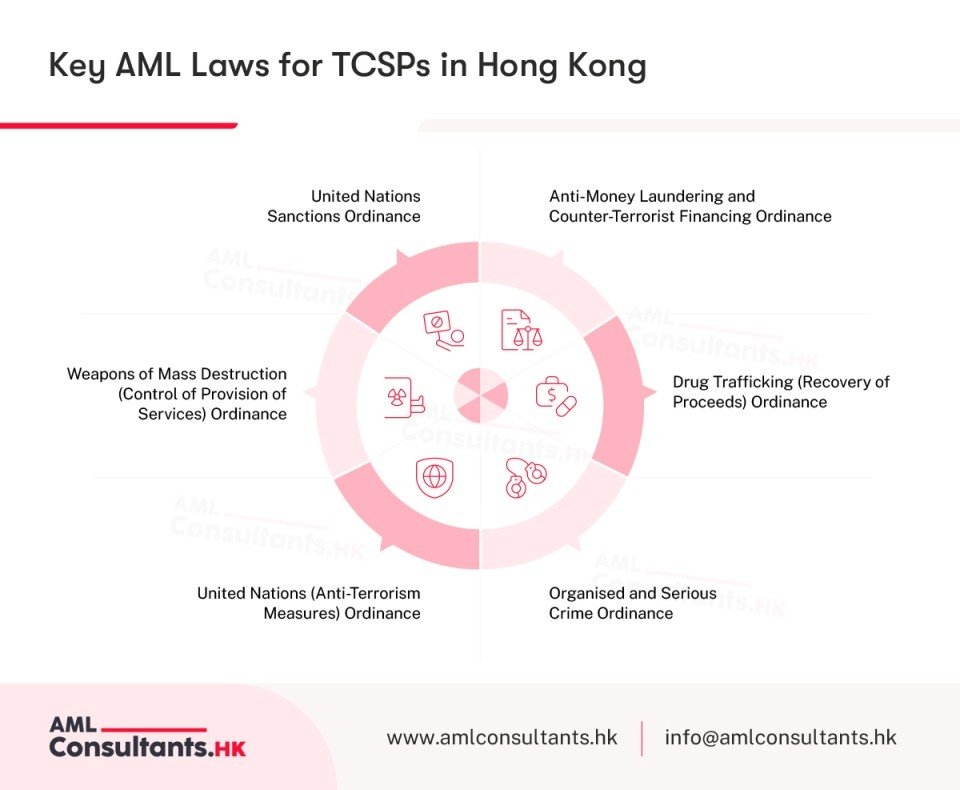
Anti-Money Laundering and Counter-Terrorist Financing Ordinance (AMLO), Cap. 615
The AMLO is the key AML law applicable to TCSPs in Hong Kong. Under AMLO, Cap. 615, Schedule 2, TCSPs are required to identify and verify their customers and maintain proper records for at least 5 years.
Drug Trafficking (Recovery of Proceeds) Ordinance (DTROP), Cap. 405
Under DTROP, Section 25, TCSPs must not deal with criminal property or proceeds of drug trafficking. Also, the framework considers ‘tipping off’ as an offence and imposes penalties on TCSPs for disclosing information regarding filing STR reports.
Organised and Serious Crimes Ordinance (OSCO), Cap. 455
OSCO mandates TCSPs to file Suspicious Transactions Report (STR) with the Joint Financial Intelligence Unit (JFIU) for suspecting or having knowledge of any criminal property.
United Nations (Anti-Terrorism Measures) Ordinance (UNATMO), Cap. 575
UNATMO is one of the AML laws for TCSPs in Hong Kong for combating terrorism. It mandates TCSPs not to deal with any property controlled or owned by terrorist or their associates. Further, the law requires freezing assets or funds relating to terrorist financing.
Weapons of Mass Destruction (Control of Provision of Services) Ordinance (WMDO), Cap. 526
WMDO, among AML laws for TCSPs in Hong Kong, forbids the production, development, or acquisition of weapons of mass destruction. The law mandates TCSPs to implement robust control measures to prevent and detect proliferation financing.
United Nations Sanctions Ordinance (UNSO), Cap. 537
UNSO requires TCSPs to screen their customers against the sanctions lists and not be involved in any trade transaction with sanctioned individuals.
Automate Uncovering Complex Layered Ownership Structures.
Get expert support to select AML software that helps you detect shell companies and identify beneficial owners faster.
AML/CFT Guidelines Applicable to TCSPs in Hong Kong
TCSPs in Hong Kong are mandated by the Guidelines on Licensing of Trust or Company Service Providers, as amended in October 2022, to register themselves and apply for a TCSP license at the Registrar of Companies. The license will be valid for 3 years, and the consequences of not applying for a license to carry out a TCSP business in Hong Kong include a fine of HK$100,000 and imprisonment for 6 months.
Further, the Registrar of Companies issued Guidelines on Anti-Money Laundering and Counter-Financing of Terrorism for Trust and Company Service Providers in March, 2025. It provides practical guidance that supports TCSP licensees in drafting and implementing policies, procedures, and controls to combat ML/TF risks.
In addition, the Guidelines on Imposition of Pecuniary Penalty, issued in March 2018 by the Registrar of Companies (the Registrar), explain penalties or fines for AML/CFT breaches imposed on TCSPs.
AML/CFT Regulatory Authorities for TCSPs in Hong Kong
The regulatory authority that supervises TCSPs in Hong Kong is the Companies Registry (CR). The authority administers the TCSP licensing regime, monitors them and ensures compliance with AMLO, Cap. 615 and the remaining AML laws for TCSPs in Hong Kong. The Registrar of Companies (the Registrar) issues TCSP AML guidelines, licensing policy and a penalties document for TCSPs to ensure compliance with international AML/CFT standards.
Further, the Registrar of Companies requires TCSPs to pass the fit-and-proper test to obtain a license. The CR also conducts inspections to determine that TCSPs meet the statutory requirements of Customer Due Diligence and record-keeping. The Registrar of Companies has the power to approve, refuse, revoke or suspend the TCSP license and impose conditions on licensees.
Does Your TCSP Business Verify Clients Rightly?
Strengthen your Customer Due Diligence Process to recognise the beneficial ownership and mitigate corporate services risks.
JFIU and AML/CFT Law Enforcement Agencies for the TCSPs Sector
The Joint Financial Intelligence Unit (JFIU) Hong Kong
The Joint Financial Intelligence Unit (JFIU) is jointly run by staff members of the Hong Kong Police Force and the Hong Kong Customs and Excise Department. The JFIU Hong Kong manages a suspicious transaction reporting regime for Hong Kong, and its role is to receive, analyse STRs and to disseminate them to the appropriate law enforcement agencies in or outside Hong Kong, or financial intelligence units worldwide.
AML/CFT Law Enforcement Agencies in Hong Kong for the TCSPs Sector
The following are the law enforcement agencies that investigate TCSPs’ involvement with ML/TF activities and ensure adherence to the AML laws for TCSPs in Hong Kong:
- Hong Kong Police Force (HKPF)
- Customs and Excise Department (C&ED)
- Independent Commission Against Corruption (ICAC)
Hong Kong NRA, SRA, and Risks Associated with TCSPs
The Hong Kong government uses the World Bank National Risk Assessment Tool to identify, assess, and understand ML/TF risks associated with the TCSP sector. It helps define the ML threats and vulnerabilities and provides an overall ML risk rating, which is medium for TCSPs.
ML threats in the TCSP Sector (Medium)
Criminals misuse TCSPs’ services, such as forming front/shell companies or selling shelf companies to obscure beneficial ownership and the source of funds.
ML Vulnerabilities in the TCSP Sector (Medium)
TCSPs have a diverse client base, including high-net-worth individuals and politically exposed persons (PEPs) from high-risk jurisdictions, which increases the ML risks.
Mitigation Measures
TCSPs must apply for a license under the Registry of Companies and must pass a fit-and-proper test. Further, TCSPs are required to comply with AMLO CDD and record-keeping requirements.
Stronger Teams Detect Risks Priorly.ster.
Create an in-house AML Compliance department to protect your TCSP business from hidden ML/TF risks and help remain compliant.
FATF and APG Guidelines Concerning TCSPs
The Financial Action Task Force (FATF) provides forty recommendations for TCSPs to follow that include implementation measures to prevent financial crime. The FATF recommendations include implementing a risk-based approach, customer due diligence, enhanced due diligence, and record-keeping. Further, the guidelines require TCSPs to implement internal controls and report suspicious transactions.
Further, the Asia/Pacific Group on Money Laundering (APG) provides ML/TF typologies and trends that help TCSPs in Hong Kong to develop effective AML/CFT policies and procedures to detect and prevent financial crime.
How AML Consultants HK Helps in Implementing Legal Framework for TCSPs in Hong Kong
AML Consultants HK helps TCSPs in Hong Kong establish institutional credibility by providing support for the In-House AML Compliance Department Setup. Further, by conducting the ML/TF Risk Assessment, AML Consultants HK ensures adoption of a risk-based approach that meets supervisory expectations for AML/CFT compliance.
Moreover, AML Consultants HK aims to identify gaps in TCSPs’ compliance policies and procedures with a proper AML/CFT health check to ensure adherence to the AML laws for TCSPs in Hong Kong.
FAQs on AML Laws for TCSPs in Hong Kong
What AML/CFT laws apply to Trust or Company Service Providers (TCSPs) in Hong Kong?
AML/CFT laws that apply to TCSPs in Hong Kong include AMLO, DTROP, OSCO, UNATMO, WMDO, IEO, and UNSO.
Are TCSPs required to obtain a license under Hong Kong AML regulations?
Yes, TCSPs must obtain a license from the Registrar of Companies under Hong Kong AML regulations, which is valid for three years. TCSPs functioning without a license are committing a criminal offence and may face penalties.
What customer due diligence requirements apply to TCSPs in Hong Kong?
Customer Due Diligence requirements under AMLO for TCSPs in Hong Kong include verifying customer identities, identifying beneficial owners, conducting ongoing monitoring, understanding business nature, and record-keeping for 5 years.
Are TCSPs required to report suspicious transactions in Hong Kong?
Yes, under DTROP, Cap. 405 and OSCO, Cap. 455, TCSPs are required to submit Suspicious Transaction Reports to JFIU for knowledge or suspicion of criminal property or proceeds of crime.
What record-keeping obligations apply to TCSPs under Hong Kong AML regulations?
Under AMLO, Schedule 2, Section 20, TCSPs are required to maintain transaction and CDD records for at least 5 years.
About the Author

Pathik Shah
Founder | FCA, CAMS, CISA, CS, DISA (ICIAI), FAFP (ICAI)
Pathik Shah is a Chartered Accountant with more than 28 years of experience working at the juncture of governance, compliance, and financial risk. His work has consistently focused on helping institutions in Hong Kong to operate confidently within regulated environments, particularly where AML/CFT obligations demand practical implementation.
As part of his role with AML Consultants HK, Pathik is involved in working with various financial institutions and DNFBPs so that not only are their AML frameworks compliant from a regulatory standpoint under the Anti-Money Laundering and Counter-Terrorist Financing Ordinance (Cap. 615), but they are also effective from a supervisory review expectations standpoint. Aside from that, Pathik has served as a functional expert in the development and deployment of RegTech solutions to enhance monitoring discipline and documentation integrity. Additionally, he has assisted institutions in understanding the FATF requirements and how to implement them within the Hong Kong context in an operationally feasible manner.
Pathik is a recognised thought leader in AML/CFT and frequently shares insights on trends in financial crime risks and developing supervisory approaches on various platforms.

Reach Out to Pathik
